Find Me on Facebook
Follow Me on Twitter
Add Me on LinkedIn
Mail Me
Read my Feeds

New Google +1 Buttons


The ubiquitous +1 buttons will soon have a new look. The updated version is available when you subscribe to the Google+ Platform Preview, at least for now.

"Following in the footsteps of our new red and white Google+ icon, the +1 button is sporting a fresh coat of paint," informs Google.
Comparing Old v/s New Google+ 1 button
While the new buttons are more consistent and include the Google+ branding, the old buttons are more colorful and more descriptive. "+1" is bigger and more obvious in the old buttons and that made them more clickable.
Here's the tiny +1 button from Google+
... and here's the +1 button from Google Groups
The small +1 buttons are not legible and it's not obvious that you're supposed to click them. As Fernando Fonseca says, "I understand the need to have a button that looks like the new logo but the problem is that a white background with a thin red line is hardly eye catching and hardly says 'Click me'."

You can compare the different versions of the +1 (v1) and +1 (v2) using the corresponding sprites. I'd choose the old buttons.
  • Digg
  • Del.icio.us
  • StumbleUpon
  • Reddit
  • Twitter
  • RSS

What IE6's slow death says about us?

Usage of Internet Explorer 6 has dropped below 1 percent. Microsoft and security pros everywhere are happy about IE6's demise.

A cake at the Hacker News Seattle Meet-up, where Microsoft announced IE dropping below 1 percent in the U.S.
Microsoft has some shtick about the whole IE6 death meme, but it's worth asking why this decrepit browser lasted as long as it did. In many respects, IE6's slow death--it was like watching paint dry--says a lot about the enterprise, which is one reason the browser stuck around as long as it did.

Here are some thoughts on the meaning behind IE6's end:
  • Corporations moved at a glacial pace. Yes Virginia, you still can get a laptop with a Windows XP image and an IE6 browser. What's it mean? A few companies still don't value modern Web standards and may never upgrade PCs again until employees walk out.
  • Enterprises boxed themselves in by programming applications to work with IE6. As Microsoft moved on, companies stayed in place. Tight budgets meant that IE6 stuck around way past its useful life.
  • People view change and then puke. You'd think a browser swap would be simple. It's odd that Microsoft had to mount a kill IE6 campaign. People--who happen to make up companies--frequently resist change. IE6 was like an old blanket that wore thin after being carried around for a decade.
  • Digg
  • Del.icio.us
  • StumbleUpon
  • Reddit
  • Twitter
  • RSS

Chrome Overtakes Firefox Globally for First Time


Free web analytics company reports that Internet Explorer still leads despite falling market share

Google's browser Chrome overtook Firefox for the first time globally on a monthly basis in November, according to StatCounter, the free website analytics company. The firm's research arm reports that Chrome took 25.69% of the worldwide market (up from 4.66% in November 2009) compared to Firefox's 25.23%. Microsoft's Internet Explorer still maintains a strong lead globally with 40.63%.

In the US Internet Explorer continues to perform strongly and is maintaining market share at 50.66%, up slightly from 50.24% year on year. Firefox retains second place on 20.09%, down from 26.75%. Chrome is up to 17.3% from 10.89%. Safari is on 10.76% from 10.71%.

In the UK, Internet Explorer also leads the market with 42.82%. Chrome is on 24.82%, having overtaken Firefox (20.56%) in July. (For other individual country or regional analysis see StatCounter Global Stats).
  • Digg
  • Del.icio.us
  • StumbleUpon
  • Reddit
  • Twitter
  • RSS

Firefox's Android reboot begins!

A new version of Firefox for Android uses the operating system's own user interface technology

It was a tough decision for Firefox on Android: improve the browser's performance or keep its compatibility with add-ons and other technology?

But after creating a prototype, Mozilla settled on the winning answer quickly: performance. And tomorrow, a month after making the decision, Mozilla plans to release an early version of the overhauled Firefox for Android.

The organization will introduce the new version on the "nightly" channel, where Mozilla tests raw new technology. With the organization's rapid-release cycle, the nightly version graduates to the Aurora, beta, and final-release channels, maturing for six weeks in each phase.

The new version is strategically important for Mozilla for multiple reasons. First, smartphones and tablets are at the center of a mobile-first transformation of the computing industry, and Firefox isn't preinstalled anywhere right now. Second, with Firefox shut out on Apple's iOS and Microsoft's Windows Phone, Android is effectively the only route for Mozilla to bring its browser to the mobile market.

Last, Mozilla's objective--to ensure an open Web--relies on Firefox. Right now, Apple and Google browsers based on the open-source WebKit project dominate mobile browsing.

Release manager Christian Legnitto announced the move Friday. Initially the new version was geared just for phones, but Mozilla expanded it to tablets, too, after concluding it couldn't offer separate versions.

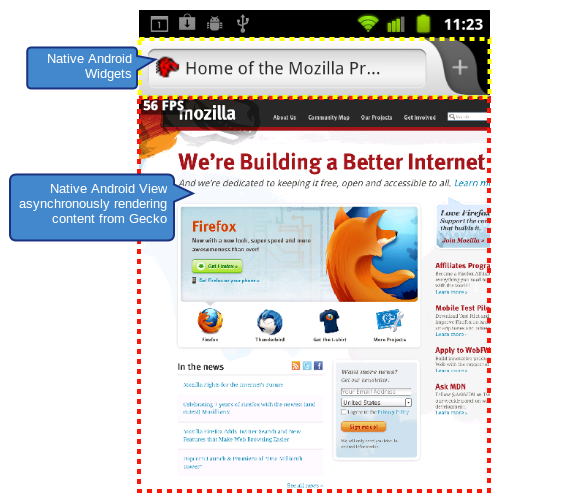
Firefox for personal computers, and many of the add-ons that helped make the browser popular by making it more customizable, use an interface called XUL (XML User Interface Language). But because the XUL-based version of Firefox took so long to start up on Android and isn't as responsive, Mozilla instead embraced Andoid's built-in technology.

Among the native interface advantages, according to programmer Mark Finkle:
  • Startup--A native UI can be presented much faster than a XUL based UI, since it can happen in parallel with Gecko startup. This means startup times in fractions of a second, versus several seconds for a XUL UI on some phones.
  • Memory Use--We believe a native UI will use significantly less memory.
  • Responsiveness--A native UI has the potential for beautiful panning and zooming performance.

It comes at a cost, though. XUL-based add-ons are one issue.
"Native UI builds are considered a new application and are not add-on compatible with the XUL versions," Finkle said

Mozilla is working on a new approach for add-ons on Android, though, through an interface called NativeWindow, Finkle said. And in a comment, Finkle added that it could be possible to build Firefox's newer Jetpack interface for add-ons atop the NativeWindow foundation.

There are other challenges, too, with the new version. The current Firefox Sync, for example, no longer works as a way to share bookmarks, passwords, and open tabs across multiple versions of the browser. A native version of Sync for Android is under construction, though, and due to arrive in December. Also being addressed is the fact that the current upgrade path drops saved passwords and browsing history.

Another list of objections came from Robert Kaiser, a Firefox project contributor, who listed his misgivings in a mailing list message: "The awesomebar algorithm [which suggests full links based on what people type in the adress bar] will be removed. The privacy of bookmarks and history will be removed. Open video might get undermined," he said. "A lot of Add-on awesomeness will be removed... Somehow I don't believe you fully there."

All these are potential problems, to be sure. But not as big as people not using the browser at all because it's too slow.
  • Digg
  • Del.icio.us
  • StumbleUpon
  • Reddit
  • Twitter
  • RSS

Samsung Smart TV

Just like mobile apps, TV apps come in a variety of categories and features, offering information, entertainment and social media networking through the living room screen. Your selection of apps expands the functionality of your TV set in the same way mobile apps define what you can do with a smartphone.


The key difference, though, is that the TV is often at the center of home and you’ll likely share the app experience with your family and friends. It is no surprise that the list of popular Samsung TV apps includes video sharing, games for family and education apps.

Just last week, Samsung Apps, our TV app store launched in February 2010, celebrated the milestones of 1,000 registered applications and 10 million downloads. With help from our Samsung Apps colleagues, Samsung Village took a look into different types and features of the most-sought Samsung TV apps.


  • As you can imagine, online video apps are at the top of the download list, both globally and regionally. These apps connect your TV set to a sea of video content on the Web and let you appreciate them on a bigger screen! YouTube ranked atop the chart, while Vimeo (video sharing) and vTuner (Internet streamed media) made it among the top five.
  • On-demand news applications are also high up on the list. The mobile Internet gave us unlimited access to news and information anytime and anywhere, so why should we wait for regular news on TV? On Samsung Smart TVs, BBC News and WSJ Live offer top news in video and text throughout the day. CNBC Real-Time app and TIME TV are popular too.
  • As family entertainment makes an important part of the Smart TV experience, games, sports and education apps are steady sellers on Samsung Apps. A variety of games are available from classic ones such as Pac-Man and Tetris to sports genre like Let’s Golf and Homerun Battle 3D, and to educational games for kids.
  • Locally specialized apps are playing a big role in the success of Smart TV apps, thanks to local insights and contributions from our diverse app developer community. “Lovefilm” in the UK, “Berliner Philharmoniker” in Germany, and “Telstra’s NRL Game Analyser” in Australia are the examples of such Smart TV apps.


By number, the game category accounts for a quarter of all the apps listed on Samsung Apps, followed by information, education and lifestyle.

As televisions become smarter and our app developing ecosystem grows, Samsung is excited to provide more apps and content that will help you enjoy the smart life!
  • Digg
  • Del.icio.us
  • StumbleUpon
  • Reddit
  • Twitter
  • RSS

Randi Zuckerberg quits Facebook; to float her own business RtoZ Media


"Who wants a tequila shot?" Randi Zuckerberg shouted over the thump of "Baby One More Time," Britney Spears' breakup anthem. It was nearly midnight on a rainy Wednesday in September, and more than a dozen friends gathered by Randi, the older sister of Mark Zuckerberg, a founder of Facebook, were crowding a private room at the Midtown karaoke club Japas 38. "Yay!" cheered the crowd as their host hoisted a carafe of tequila in the air and circled the tables, pouring shots. The air smelled of stale beer and soy sauce.

After salt was licked, plastic cups drained and limes squeezed, she grabbed a microphone and belted out a rousing version of "I Will Survive." In August, Randi Zuckerberg, 29, quit her job at Facebook, where she had been among the first two dozen people hired. Most recently, she was the director of marketing. In its early days, Zuckerberg was a buoyant presence, representing her reticent brother to an eager press. Later, she earned attention (not always favorable ) singing at company functions with a band composed of colleagues.

And she came up with the idea for Facebook Live, the social network's video channel, which has featured interviews conducted by Facebook executives with Oprah Winfrey and President Barack Obama. Now Zuckerberg has started her own business, RtoZ Media, to help companies take advantage of social media. "This is the launch party of Randi Zuckerberg!" she said at the club, beaming.

Zuckerberg, who lives in a rented house in Palo Alto, has ambitions beyond the internet. "I want a talk show," she said two days earlier over drinks at the Mercer Hotel. She also wants to sing on Broadway. And she is interested in philanthropy: while in New York, she conducted live online interviews with participants of the Clinton Global Initiative and worked the red carpet at a UN gala.

Older women who are mentors, Zuckerberg said, have warned her that she must tone down her flamboyant persona, but she refuses to take heed. "This is a new world we live in, and it should be possible for a woman to be taken seriously and still do what she loves," she said. Three weeks after the karaoke night, she spoke at a conference sponsored by the New York Stock Exchange. She then traveled to Warsaw to talk to 2,000 telecom and media executives about social media. And the estate of Michael Jackson hired her to be the host of an online show on the pop star's Facebook page. "Every article written about me now refers to me as Randi Zuckerberg, Mark's sister," she said. "Maybe one day that won't be what people say about me."

Zuckerberg was born in 1982 and grew up in Dobbs Ferry, NY, a Hudson Valley town about 40 minutes from Manhattan. She is older than Mark by two years and has two younger sisters. Early on, her parents signed her up for piano lessons, but she longed to sing. She enrolled at Harvard in 1999 and studied psychology after being turned down by the music department, she said, because her piano skills were lacking. She continued to sing, using the stage name Randi Jayne. In 2002 her brother joined her at college.
  • Digg
  • Del.icio.us
  • StumbleUpon
  • Reddit
  • Twitter
  • RSS

Galaxy Nexus by Google

Google's new Galaxy Nexus is made by Samsung and will launch in November

Google has announced its much-awaited new phone, the Galaxy Nexus, and also released a new version of its Android phone software. Codenamed Ice Cream Sandwich, Android 4.0 will be available to existing Android users soon and is available to software developers now. The Galaxy Nexus will launch in November.

Take a look at our backstory video for more on the vision behind this product and to understand why we think “a thousand heads are better than one”:


Among the Galaxy Nexus’s new feature are face recognition, allowing users to unlock their phones simply by looking at the phone’s front camera, a redesigned interface, an improved keyboard and a new application using Near-Field Communications (NFC) that lets two Android handsets share content directly.

The phone also replaces all physical buttons with software-based, moveable equivalents. The change allows a larger, 4.65” screen, which like the previous Nexus S model is slightly curved.

Running a 1.2Ghz processor, the Galaxy Nexus will be made by Samsung and also offers a high-definition display. It had been rumoured that it would be called the Nexus Prime, but instead the Korean manufacturer and Google have explicitly linked the device to Samsung's best-selling Galaxy range.

Writing on the Google Blog, the company’s Senior Vice President of Mobile, Andy Rubin, wrote that “Ice Cream Sandwich makes Android simple and beautiful, and takes the smartphone to beyond smart”.

Ice Cream Sandwich is the first version of Android to run on both tablets and phones, and Google has even created a new, optimised font for the purpose. Google claims that widgets have been improved dramatically, and also said that it would provide the “best mobile Gmail experience to date”, including some offline search options.

Gingerbread is the fastest version of Android yet, and it delivers a number of improvements, such as user interface refinements, NFC support, a new keyboard and text selection tool, Internet (VoIP/SIP) calling, improved copy/paste functionality and gyroscope sensor support.

Here’s a glimpse of the “magic” of Google on Nexus S:


Web bookmarks now synchronise with Google Chrome, and zooming out of the calendar now allows users to move to different views, going from daily to monthly, for instance.
Although many phones, such as the newly announced Motorola Razr and the Samsung Galaxy SII offer 8 megapixel cameras, the Galaxy Nexus uses a 5mp version.

Rubin said that more than half a million Android devices are now being activated every day.

Announced in Hong Kong at an event originally planned for San Diego but postponed after the death of Apple co-founder Steve Jobs, reactions to the new Galaxy Nexus were broadly positive. Writing on technology blog This is My Next, Vlad Savov said that the interface, set-up and synchronising were all improved. He added, however, that on the pre-production models shown in Hong Kong “Android isn’t as swift and responsive as iOS or Windows Phone”.
  • Digg
  • Del.icio.us
  • StumbleUpon
  • Reddit
  • Twitter
  • RSS

Google's Android Market is undergoing renovation

The Android app store will soon launch several new updates in its upcoming 1.6 version, according to an Android Developers blog post from Google's Eric Chu on Thursday.

Developers will be able to provide screenshots, icons, and descriptions to better promote and highlight their applications.
Four new app subcategories--sports, health, themes, and comics--are being added, Chu said. Developers can target any of those subcategories for both new and existing applications.

For reasons Chu did not explain, Android app developers in Italy are getting some special attention. Italian developers will be able to call up the publisher's site to upload their applications and specifically target any country where paid apps are currently available to customers.

In a video accompanying Chu's blog, the updated interface--as rumored--also reveals new buttons for Top Paid, Top Free, and Just In, as well as a search button in the upper right corner of the screen.


Google unveiled Android Market a year ago as the Android equivalent to Apple's iTunes Store. Since its debut, Google has tried to attract developers to publish their apps to the store. Initially, only free apps were available. But in January, Google opened the market to paid software in an effort to lure more developers.

Google has offered other carrot sticks to attract developers, such as its annual Android Developer Challenge, which offers prizes to programmers with the best apps.

However, a recent survey from AdMob found that less than half of Android phone owners have purchased an application, citing the lack of hot apps and limited payment options.
  • Digg
  • Del.icio.us
  • StumbleUpon
  • Reddit
  • Twitter
  • RSS

Ten Intriguing Things We Should Know About Google TV


Internet giant Google is all set to enter your living room. The Silicon Valley company is launching a service that includes Google Search and merges applications and a Web browser with television programming.

Google TV will serve as an `entertainment hub' that lets viewers search channels, recorded shows and websites.


Here's looking into Google TV, the innovation that has been called `the biggest improvement to television since colour'.

1. What it is?

Google TV aims to turn the TV into a regular internet terminal, allowing people to access services like Facebook, Twitter or any internet site while they are watching programmes on a split screen.

In a demonstration, Google showed a TV screen with an Internet search box. A search for a particular TV programme got both the programme playing on a traditional channel, and related episodes along with other content available online.

2. Who will make hardware?

Google will provide the software, while Sony will make the TVs with Intel chips, and Logitech will supply a special remote control and wireless keyboard.

The service will be incorporated into televisions and Blu-ray players made by Sony and set-top boxes from Logitech.


3. Software engine?

Google service will run on the company's mobile platform, Android operating system that is increasingly gaining traction in smartphone market. It also will use the Chrome browser.

Based on Android platform, Google TV will turn Android phones into controls that can be used in the same room as the television or remotely across the Web.


4. Ads on GoogleTV?

Google did not talk about its advertising strategy for Google TV. The company isn't currently selling ads specifically designed for the new platform, said Rishi Chandra, a product manager at Google. Users could see Google's ads as they browse Web sites when accessing the Internet on the new TV service.

"We want to get the product experience right first," Chandra said. "Over time, there will be opportunities to really rethink how ads can actually work better on this TV experience."
5. Search on TV?

According to Google, Google TV will be using search to give users an easy and fast way to navigate to television channels, websites, apps, shows and movies. For example, if a user already knows the channel or programme he wants to watch, all he needs to do is type in the name and he will be there.


6. Open source platform?
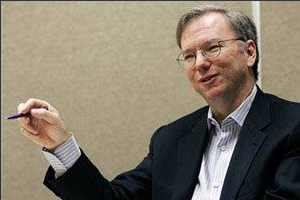
Since Google TV is built on open platforms like Android and Google Chrome, third-party developers will be able to build applications for it. In its announcement at Google I/O, the company challenged Web developers to start coming up with the Web and Android apps designed specifically for the TV experience.

Soon after launch, the company will release Google TV SDK and web APIs for TV so that developers can build applications and distribute them through Android Market.


7. Use Your Smartphone As A Remote?


Remote control apps will be available for iPhone, iPad and Android devices. These free apps will allow you to use your smartphone like a regular remote and will also accept voice commands. You can use multiple phones to control the same TV.


8. Add-ons?

Google TV service will include video-on-demand products from Amazon.com, Netflix and Hulu, a video site partly owned by Walt Disney, Google said at the conference.


9. Threats?

The effort is likely to face formidable challenges. One, Google will need to persuade TV manufacturers other than Sony to use its software, as well as retailers to sell the devices.

Also, in the past too several companies have already tried to bridge the gap between the TV and the Web with little success. Microsoft for example, has for years sought to make technology that can blend Internet and TV content. Apple too has offered its Apple TV device for transmitting Internet content to TV.

Google executives said that previous efforts failed because they dumbed down the Web for television, were closed to participation by others, and made people choose between using the Web or television.


10. Pricing & availability?

Google and its partners said the service would be free and prices for Sony's TV and Logitech's box would be announced at a later date.

While Google TV will be launched around Christmas in the US, international launch is expected in 2011.
  • Digg
  • Del.icio.us
  • StumbleUpon
  • Reddit
  • Twitter
  • RSS

Google India

Bangalore

Google India Pvt Ltd
No. 3, RMZ Infinity - Tower E
3rd, 4th, and 5th Floors
Old Madras Road
Bangalore, 560 016
India
Phone: +91-80-6721-8000


Gurgaon

Google India Pvt Ltd
8th and 9th Floors
Tower C Building No.8
DLF Cyber City
Gurgaon India
Phone: +91 124 451 2000
Fax: +91 124 451 2100


Hyderabad

Google India Pvt Ltd
Block 1, DivyaSree Omega
Survey No. 13, Kondapur Village,
Hyderabad 500 032
Andhra Pradesh, India
Phone +91-40-6619-5000
Fax +91-40-6619-5101


Mumbai

Google India Pvt Ltd
264-265 Vasvani Chambers
1st Floor
Dr Annie Besant Road
Mumbai, 400 025
India
Phone: +91-22-6611-7200


  • Digg
  • Del.icio.us
  • StumbleUpon
  • Reddit
  • Twitter
  • RSS

Google amazingly goes mobile for Alexander Calder's 113th birthday

A piece of kinetic art took the place of the usual Google logo to celebrate the 113th birthday of American artist and sculptor Alexander Calder.

Friday's Google doodle shows a mobile, a type of kinetic sculpture that was invented by Alexander Calder. Mobiles take advantage of the principle of equilibrium and have objects hanging from rods. Kinetic art uses motion for an artistic effect.

Mobiles are usually brightly coloured free-moving creations in abstract shapes made from sheet metal. The mobile Google doodle sways on its own and can also be controlled by mouse gestures.


Calder was born on July 22, 1898 in Lawnton, US to a family of artists. While his father and grandfather were both sculptors, his mother was a painter.

He graduated with a degree in mechanical engineering from the Stevens Institute of Technology in Hoboken, New Jersey, in 1919. He then took art lessons. After a brief career in commercial art, Calder moved to Paris and put up an exhibition of a miniature circus with toy-like animals made of wood and wire. In Paris he formed associations with renowned artists and their influence helped him shape his art.

Calder was also a jewellery designer, an interest that developed when he was fashioning a wedding ring for his marriage with Louisa Cushing James. Besides his sculptures, Calder also illustrated a number of books. Besides mobiles, he also earned a name with stabiles, a type of stationary abstract sculptures.

With the years Calder also scaled up the size of his mobile and stabile installations. Calder died at the age of 78 on November 11, 1976. Two months after his death, Calder was honoured with United States' highest civilian honour, the Presidential Medal of Freedom.

Interactive and animated Google doodles have now become a regular feature on the Google home page. The last such doodle was during the total lunar eclipse of June 15-16 when Google put up its first live doodle that refreshed itself every two minutes to reflect the stage of the moon.

For a dozen years, Google has been occasionally swapping its everyday logo for a doodle, a sketch celebrating holidays, inventions, artists and sporting events, and showcasing designs from contest-winning students.
  • Digg
  • Del.icio.us
  • StumbleUpon
  • Reddit
  • Twitter
  • RSS

UNESCO declares Indian National Anthem is best!

A month ago an sms was received stating, “News to be proud for every Indian! Our national anthem has been declared best anthem in the world by UNESCO! Pass this sms to all Indians. Jai Hind!" The point is, who is UNESCO to decide which nation’s national anthem is the best? Every citizen of every nation is proud of their national anthem. And do we need some foreign body / organization to declare that our national anthem is the best and only then we are going to feel proud about being an Indian? It's high time that we all Indians should be patriotic about our country without any third party / organization / nation's recommendation! And it's a sincere request to all, not to fall prey to such sms campaigns! Be always a proud Indian!
  • Digg
  • Del.icio.us
  • StumbleUpon
  • Reddit
  • Twitter
  • RSS

How to Install Tally 9

Method 1:
  1. Click INSTALL.EXE from the CD

Method 2:
  1. Click START from Windows
  2. Select RUN
  3. TYPE <CD drive>:\INSTALL
  4. Press ENTER
The Tally 9 Setup Wizard is displayed.

Follow the instructions that appear on your screen to install Tally.


1. Click Next to continue

2. The Installation wizard displays the License Agreement


3. Read the license agreement before you proceed. Click I Agree to continue. Click I Decline to stop the set-up or click Back to go to the previous screen


4. In the Installation screen, you may accept the suggested directories. Else, click Change Application Directory or Change Data Directory or Change Configuration Directory or Change Language Directory to change the respective directory paths. Use Tab or the mouse to change the path in any of the directories

Application Directory

The Tally program files reside in this directory.


Data Directory

The Tally data resides in this directory.

The default directory where data is stored is C:\Tally\Data. To change click on Change Data Directory button and enter the new directory.

When Tally is installed in a directory with an earlier version, it detects and retains the data configuration path of the previous installation.


Configuration Directory

Tally configuration files reside in this directory.

You can specify the path of the directory where the configuration files should be saved. It is usually the same path as the Application Directory.


Language Directory

Tally Language files (.dct) reside in this directory.

You can specify the path of the directory where the Language files will be maintained. It is usually the same path as that of the Application Directory.

Note: If you are a Multi-License User, select the Run Tally License Server at Windows Startup check box
5. Click Install Operating System Language Support to enable Language Support

6. Select your Country name in Country Selection

7. Select the Initial Startup Language from the list. When you start Tally for the first time, Tally will appear in the language selected as the Initial Startup Language


8. Click Install

The installation progress status is displayed as shown below.


9. Insert Windows CD to install language or Browse for the i386 folder in your system

Note: You will be prompted to install the i386 language support folder only if it is not available in your system

10. Click OK to install Language Support

11. Click Finish to complete Setup


You are now ready to use Tally. You can click the Tally program icon on the desktop.

Enjoy the Power!
  • Digg
  • Del.icio.us
  • StumbleUpon
  • Reddit
  • Twitter
  • RSS

Firefox 5.0 versus Chrome 12.0 – which is better ?

#1 Features :

Firefox 5 has arrived with lot of changes and features such as ‘Do not track’, which allows users to control – how their behavior and data are being tracked or used on the internet. Firefox 5.0 has focused on adding social and useful features (such as PDF Viewer, Sync etc,) related to common desktop users that was already available in its competitor web browsers such as Chrome. Features can be easily added by means of plugins – and Firefox has a number of useful plugins available free to use.

Important features of Firefox 5.0

  • Do not Track
  • Social sharing options
  • PDF Viewer
  • MP3 Player
  • Small home icon
  • Colored search (engine) bars
  • Improved sync feature
  • Multiple account login

On the other hand Google chrome has also added a lot of new and exciting features in vs 12.0. It has already most of the features implemented, what Firefox got now, Google has continuously trying to add cutting edge – innovative features to chrome. eg HTML 5 performance/support, hardware accelerated 3D CSS (which allow developers to create better animation effects in the browser, e.g in browser based games) etc. Plugins are available but the number is very less and it’s not so useful as compare to Firefox, despite of having better plugin architecture than Firefox. Firefox Wins in this case.

Some important features include -

  • Malicious file download protection
  • Hardware accelerated 3D CSS support
  • Improved screen reader support

#2 Performance :

Firefox performs well in Windows and Mac based OS but it sucks when it comes to Linux based operating system, After the major release of Firefox (I mean after version 4.0), we expected better performance on Linux distros such as Ubuntu or Fedora, but things got bad, surely it’s not better than before. If you will use any plugin, then the performance is extremely bad.

On the other hand, Google Chrome rocks on Linux based OS as well as on Windows and Mac. The performance is quite well as compared to Firefox, on Ubuntu or other Linux based operating system. Chrome Wins!

#3 Stability :

Firefox often hangs if a number of tabs is open (specially on GNU/Linux) wile Chrome is stable. So Google Chrome is far stable than Firefox. Chrome wins in this case.

#4 Security :

Both are secure but chrome had added some special features to protect users from downloading malwares or other infected files. Firefox seems better!

#5 Speed :

Firefox has improved speed a lot, because speed is the most dominant factor while choosing the browser for common purposes. Firefox supports HTTP pipelining which can improve the browsers speed a lot but it may cause instability, while chrome doesn’t support this. Google Chrome is fast from the beginning! Google chrome has added some advanced functionality such as Pre DNS fetching (The links pointed (from the current page) to other domain names are resolved before the user clicks on that link), Loading pages before the completion of URL in address bar etc, to improve the surfing speed. Chrome Wins!
  • Digg
  • Del.icio.us
  • StumbleUpon
  • Reddit
  • Twitter
  • RSS

Mark Zuckerburg is the most popular user on Google+

https://lh3.googleusercontent.com/-eVWmjui0KvU/Th6vchCCQiI/AAAAAAAAAxk/DqAJVLurSfk/s512/zuckerberg-tops-google%25252B.jpg 

Just days after the launch of Google+ it has become clear who is the king of social networking:  none other than Facebook’s Mark Zuckerberg, the most popular Google plus user.  He bested Google founders Larry Page and Sergey Brin by a long shot.  As noted on TechCrunch, Zuckerberg already has the “most friends in the world” and they did make a movie about him.  Never-the-less, I doubt the Googlers never anticipated his rise to the top of their soon-to-be social networking empire.
  • Digg
  • Del.icio.us
  • StumbleUpon
  • Reddit
  • Twitter
  • RSS

Google doodle marks the 450th anniversary of Saint Basil's Cathedral

Google marks the 450th anniversary of Moscow's Saint Basil's Cathedral with a commemorative doodle on its home page. Known by various names, including the Cathedral of the Protection of Most Holy Theotokos on the Moat, Saint Basil the Blessed, Pokrovsky Cathedral, Russian Svyatoy Vasily Blazhenny and Pokrovsky Sobo, it was built by Tsar Ivan IV (the Terrible) to commemorate Russia's victories over Kazan and Astrakhan.
The construction of the Russian Orthodox church began in 1554 and was completed in 1561. Originally named the Holy Trinity Cathedral, over the centuries it became known as the place where St. Basil is buried. The church is located at Red Square, the centre of the city of Moscow.
Russia will celebrate the 450th anniversary of St. Basil's Cathedral by opening an exhibition dedicated to the so-called "holy fool" who gave his name to the soaring structure of bright-hued onion domes that is a quintessential image of Russia.
Google doodle marks the 450th anniversary of Saint Basil's Cathedral
The eccentrically devout St. Basil wore no clothes even during the harsh Russian winters and was one of the very few Muscovites who dared to lambast tyrannical Czar Ivan the Terrible.
Ivan, whose gory purges claimed tens of thousands of lives, feared St. Basil as "a seer of people's hearts and minds," according to one chronicle. He personally carried St. Basil's coffin to a grave right outside the Kremlin. The cathedral, constructed to commemorate Ivan's victory over Mongol rulers, was built on the burial site.
The structure was designed by two Russian architects, Posnik and Barma. Some sources, though, attribute it to an Italian architect who was blinded after the completion so that he could never build anything as majestic again. The structure got its vivid colours, in which we can see it today, in several stages from the 1680s to 1840s.
The building was severely shelled during the 1917 Bolshevik takeover of the Kremlin and was patched up during the subsequent civil war and famine.
Early Communist leaders - who persecuted countless clerics of all faiths and destroyed tens of thousands of religious buildings - wanted St. Basil's dynamited as it blocked the way to military parades, and only the cathedral's conversion into a museum saved it.
A century earlier, Napoleon Bonaparte also ordered St. Basil's blown up during his army's hasty retreat from Moscow in 1812, but a heavy rain put down the burning fuses.
The design of its nine onion-shaped, multicoloured domes combine the traditions of Russian wooden architecture with Byzantine and Islamic influences into a unique structure.
Batalov said the restoration focused on recreating the way the building looked by the late 17th century, when the nine domes were united by a wraparound floor.
By that time, St. Basil's became a symbolic New Jerusalem and the center of Palm Sunday walks, when the Moscow Patriarch approached it sitting on a donkey to recreate Jesus' arrival in Jerusalem.
Google occasionally swaps its logo for an artistic doodle These Google doodles have gained immense popularity over the past few years and the Google doodle team has put out commemorative doodles on numerous events of international or national importance, ranging from news events, civic milestones, birthdays, death anniversaries and important dates in history.
Apart from the static image doodles Google also puts up animated and interactive doodles. The last interactive doodle was to celebrate the 96th birthday of the country and jazz guitarist, songwriter and inventor, Les Paul. 

  • Digg
  • Del.icio.us
  • StumbleUpon
  • Reddit
  • Twitter
  • RSS

Facebook's Mark Zuckerberg 'invades' Google Plus

Barely has Google+ —the search giant's answer to Facebook— gotten off the ground, that it received a most unexpected 'visit' from Facebook founder Mark Zuckerberg.

Tech site CNET reported that at least three profiles bearing Zuckerberg's name had appeared on Google+, one labeled as "Fake Zuckerberg," and two as "Mark Zuckerberg."

As of Friday, it said that the "fake" Zuckerberg and one of the two "Mark Zuckerberg" profiles appeared to have been short-lived.

However, the "remaining" Zuckerberg profile appeared to be still up, with no posts.

"The second Mark Zuckerberg profile, put up shortly after the first was taken down, is harder to dismiss. The non-smiling profile picture--an apparent cell phone or a Webcam shot--is not easily found elsewhere. A TinEye search turned up only the Zuckerberg Google+ profile image," CNET reported.

CNET also quoted a Google spokesperson as saying that Google does not authenticate users at this time.

"As with many of our products, we rely on our users and the community to report any impersonations. We then review these reports and act accordingly. You can try to determine if someone is who they claim to be by viewing their profile, posts, etc. Or if you know them, you can contact them directly," it quoted the spokesperson as saying.

CNET also said that Facebook has not responded to its requests to verify the second Zuckerberg Google+ profile.
  • Digg
  • Del.icio.us
  • StumbleUpon
  • Reddit
  • Twitter
  • RSS

Upgrade to Joomla 1.6 or stick with J1.5?

content construction for joomla

There has been a lot of confusion around Joomla 1.6 recently. After 3 years of heavy coding this major upgrade has been finally released in early 2011. Right now many users are wondering what 3rd party support for J1.6 will look like in the next months. Does it make any sense to start a website in J1.6 at the moment? How long should I wait until making any movements for my clients?

This is how the development plan for coming Joomla core versions look like. Based on that it might be easier for you to make judgements whether and when to upgrade or build new sites in J1.6 for your clients.

Andrew Eddie, Joomla co-founder and core developer stated following on Joomla's people portal:
Finally, the developer portal outlines the new development strategy that is now in process: http://developer.joomla.org/strategy.html
In summary what this means is:

Release
Date
Maintenance Till
Joomla 1.5
Jan 2008
Apr 2012
Joomla 1.6
Jan 2011
Aug 2011
Joomla 1.7 (Bowerbird)
Jul 2011
Feb 2012
Joomla 1.8 (Cool Name?)
Jan 2012
Long Term Support

  • Joomla will release a new version of the CMS every 6 months, starting from Jan 2011 (the 1.6 release).
  • We are actually in the Joomla 1.7 (Bowerbird) development phase.
  • Development contributions for 1.7 are currently being accepted and should be made via the JFT, either by patch or referring to a branch.
  • Nobody can say what will be in Joomla 1.7 until the JFT is analysed and contributions are accepted.
  • Developers have the option of working on features that may take longer than six months to develop and target a future version (eg, skip contributions for a major feature in 1.7 because there simply isn't enough time and aim for 1.8).
Developers who are concerned about the magnitude of change should monitor the JFT closely to ensure there are no surprises that affect them. Given there is less than 3 months left to accept contributions for 1.7 (and these must be in fully working condition), it is likely that 1.7 will be a very "light" upgrade from 1.6.
  • Digg
  • Del.icio.us
  • StumbleUpon
  • Reddit
  • Twitter
  • RSS

Google & Microsoft: A curious case of trust deficit

The antitrust probe into Google invites comparisons to the case against Microsoft.

But however easy the links are to make, many are also facile. The most significant resemblance between the two situations may be their outcomes.

Google is seen in some circles to be using its dominance in one area to muscle unfairly into others, as Microsoft did. There's even some similar nerdish arrogance. Microsoft founder Bill Gates was famously testy about being deposed by the powers that be. Google's Eric Schmidt and Larry Page recently declined a request by a US Senate subcommittee to testify.

Yet the prosecution's case against Microsoft was relatively simple. Windows held about 95 percent of the market for PC operating systems in the late 1990s. Microsoft forced computer makers to use its Internet browser if they wanted to sell machines running Windows. Customers were constrained. Downloading a rival browser wasn't easy and switching to a machine not running Windows was painful.

Add it all up and Microsoft had a monopoly, abused its position and government intervention was the only immediate cure.

Google's situation is more complex. The firm claims only about two-thirds of the US search market, and its share is increasing slowly. Rivals also accuse Google of putting its services first. For example, its own maps might turn up in search results. But customers can easily use other search engines or type in a website address directly, and search doesn't appear to be a utility in need of regulation.

Smartphones could make a more compelling study. More than a third are now powered by Google's Android, according to comScore, and the figure is growing quickly.

Apps are a potential way to lock in consumers. Withholding the system's latest version from handset makers that favor a rival's services could be a potent stick for Google to wield. Yet its current market share should preclude any immediate challenge.

Though the Microsoft case was simpler, it still took over a decade to resolve. And the most important result was the company pledging to restrain itself.

The Google probe could uncover most anything, but for now the tortuous path and the end result are starting to look like they might be the real kinship to Microsoft.
  • Digg
  • Del.icio.us
  • StumbleUpon
  • Reddit
  • Twitter
  • RSS

WordPress versus Joomla! CMS - the purpose matters

When you are looking to create a website, you will probably try some of the content management systems or commonly called CMS. Two of the most popular among them are Wordpress and Joomla. In this article I will try to explain some of the major advantages and disadvantages of those systems.

I would like to start with Wordpress, which is one of the easiest for use systems available today in the internet. Although, many people think that the Wordpress can be used for blogging only, you can easily configure it to work in many other ways. Furthermore, to install that CMS on a server is really easy. That way you will allow people, who do not have any knowledge in web development to create their website for just a couple of hours. Furthermore, you will not have to develop additional scripts to get the comments of other visitors for example, because they are already built in it. On the other hand, Wordpress do not provide suitable workspace for developers, because when you try to make some modifications in it, for example to create a shopping cart, the whole system is likely to crash. Furthermore, you will not find proper advice from the Wordpress community, because they mainly complain about the features of that system. Finally, when you try to upgrade your existing system, you will usually end up having a lot more bugs than you used to.

Joomla on the other hand is one of the best content management systems for designers, web developers and administrators. That system allows all its users to create great looking websites and also it is really easy for use, by beginners. Furthermore, there are many developers, who create tools, which rapidly improve the performance of Joomla. If you are a developer, you can choose that system, because it offers large capacity for customization and development. Joomla’s features are constantly improving in the past 3 years and so you will enjoy many more features. However, when you take a look at the user interface of that system, you will find that actually is not so easy for use by people, who do not have any idea of web development and also it is far from user friendly. Furthermore, after the recent update of that system to version 1.5.x, there are still many users, who stick to the old one.

In conclusion, I would like to say that the choice between those systems depends on the purpose of your website and also on your knowledge of web development and design. In addition, when you compare the simplicity of both those systems, you will notice that working with Wordpress is a lot easier, so there are many beginners, who choose it instead of Joomla. When you take a particular project, you should check exactly what are the requirements of your client, before you choose any of these content management systems.
  • Digg
  • Del.icio.us
  • StumbleUpon
  • Reddit
  • Twitter
  • RSS