Find Me on Facebook
Follow Me on Twitter
Add Me on LinkedIn
Mail Me
Read my Feeds
Showing posts with label Android. Show all posts

Firefox's Android reboot begins!
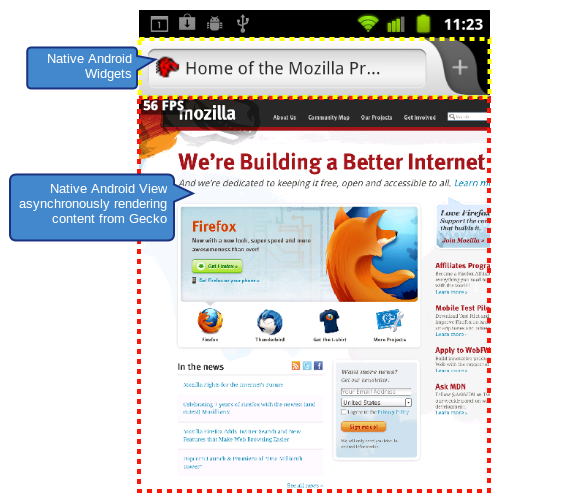
A new version of Firefox for Android uses the operating system's own user interface technology

It was a tough decision for Firefox on Android: improve the browser's performance or keep its compatibility with add-ons and other technology?

But after creating a prototype, Mozilla settled on the winning answer quickly: performance. And tomorrow, a month after making the decision, Mozilla plans to release an early version of the overhauled Firefox for Android.

The organization will introduce the new version on the "nightly" channel, where Mozilla tests raw new technology. With the organization's rapid-release cycle, the nightly version graduates to the Aurora, beta, and final-release channels, maturing for six weeks in each phase.

The new version is strategically important for Mozilla for multiple reasons. First, smartphones and tablets are at the center of a mobile-first transformation of the computing industry, and Firefox isn't preinstalled anywhere right now. Second, with Firefox shut out on Apple's iOS and Microsoft's Windows Phone, Android is effectively the only route for Mozilla to bring its browser to the mobile market.

Last, Mozilla's objective--to ensure an open Web--relies on Firefox. Right now, Apple and Google browsers based on the open-source WebKit project dominate mobile browsing.

Release manager Christian Legnitto announced the move Friday. Initially the new version was geared just for phones, but Mozilla expanded it to tablets, too, after concluding it couldn't offer separate versions.

Firefox for personal computers, and many of the add-ons that helped make the browser popular by making it more customizable, use an interface called XUL (XML User Interface Language). But because the XUL-based version of Firefox took so long to start up on Android and isn't as responsive, Mozilla instead embraced Andoid's built-in technology.

Among the native interface advantages, according to programmer Mark Finkle:
  • Startup--A native UI can be presented much faster than a XUL based UI, since it can happen in parallel with Gecko startup. This means startup times in fractions of a second, versus several seconds for a XUL UI on some phones.
  • Memory Use--We believe a native UI will use significantly less memory.
  • Responsiveness--A native UI has the potential for beautiful panning and zooming performance.

It comes at a cost, though. XUL-based add-ons are one issue.
"Native UI builds are considered a new application and are not add-on compatible with the XUL versions," Finkle said

Mozilla is working on a new approach for add-ons on Android, though, through an interface called NativeWindow, Finkle said. And in a comment, Finkle added that it could be possible to build Firefox's newer Jetpack interface for add-ons atop the NativeWindow foundation.

There are other challenges, too, with the new version. The current Firefox Sync, for example, no longer works as a way to share bookmarks, passwords, and open tabs across multiple versions of the browser. A native version of Sync for Android is under construction, though, and due to arrive in December. Also being addressed is the fact that the current upgrade path drops saved passwords and browsing history.

Another list of objections came from Robert Kaiser, a Firefox project contributor, who listed his misgivings in a mailing list message: "The awesomebar algorithm [which suggests full links based on what people type in the adress bar] will be removed. The privacy of bookmarks and history will be removed. Open video might get undermined," he said. "A lot of Add-on awesomeness will be removed... Somehow I don't believe you fully there."

All these are potential problems, to be sure. But not as big as people not using the browser at all because it's too slow.
  • Digg
  • Del.icio.us
  • StumbleUpon
  • Reddit
  • Twitter
  • RSS

Google's Android Market is undergoing renovation

The Android app store will soon launch several new updates in its upcoming 1.6 version, according to an Android Developers blog post from Google's Eric Chu on Thursday.

Developers will be able to provide screenshots, icons, and descriptions to better promote and highlight their applications.
Four new app subcategories--sports, health, themes, and comics--are being added, Chu said. Developers can target any of those subcategories for both new and existing applications.

For reasons Chu did not explain, Android app developers in Italy are getting some special attention. Italian developers will be able to call up the publisher's site to upload their applications and specifically target any country where paid apps are currently available to customers.

In a video accompanying Chu's blog, the updated interface--as rumored--also reveals new buttons for Top Paid, Top Free, and Just In, as well as a search button in the upper right corner of the screen.


Google unveiled Android Market a year ago as the Android equivalent to Apple's iTunes Store. Since its debut, Google has tried to attract developers to publish their apps to the store. Initially, only free apps were available. But in January, Google opened the market to paid software in an effort to lure more developers.

Google has offered other carrot sticks to attract developers, such as its annual Android Developer Challenge, which offers prizes to programmers with the best apps.

However, a recent survey from AdMob found that less than half of Android phone owners have purchased an application, citing the lack of hot apps and limited payment options.
  • Digg
  • Del.icio.us
  • StumbleUpon
  • Reddit
  • Twitter
  • RSS

Google's choice: Chrome OS or Android?

Sergey Brin, speaking to reporters at Google I/O.
(Credit: Google)
SAN FRANCISCO--Google isn't the only big tech company with two operating systems. But it's the only one with two that take such a different approach.
Android and Chrome OS each got a day to themselves here at Google I/O a conference designed to fire up programmer interest in Google's technology.
With the new Android 3.1, an update to the tablet-centric Honeycomb version, Google yesterday added the ability for people to plug in keyboards, mice, game controllers, and many other USB and Bluetooth devices. In short, it's making the tablet more into a PC, architecturally speaking.
But today, the news was all about Chrome OS, a browser-based operating system that transforms new laptops from Samsung or Acer into vessels for Web applications.
Two days, two philosophies. In one, the device in front of you runs the applications natively, a method that would be old school except that new smartphones are powering an explosion of new programmer interest. The other is the ultimate expression of cloud computing, where a server at the other end of the network is running the show and you just have a powerful remote control.
Google, though, thinks there's room for both. There's no cage-match-to-the-death, two-will-enter-but-only-one-will-come-out-alive approach, Google co-founder Sergey Brin said while talking to reporters today after Google announced the first Chrome OS laptops.
"It's a great dilemma to find ourselves with two fantastic successes on our hands," Brin said, perhaps a little grandly given that the Chromebooks won't even ship until June 15 much less prove themselves a success. "We'd consider ourselves fortunate to have either Android or Chrome OS," he added, implying that instead it has an embarrassment of riches.
Acer Chromebook: Google's take on the Netbook
(Credit: Acer)
The company's biggest rivals also have two operating systems. Microsoft has Windows and now Windows Phone 7 for mobile devices. Apple has Mac OS X and iOS. Though there are some synergies here and there--perhaps more as ARM-based computers spread and as the mobile OSes grow up--those operating system projects are separate.
But they're still philosophically similar: a device with a processor, input hardware, and an output display is at the center of its own little universe. Google has a much more distributed view of the world.
Of course, even with Android, the cloud is important. It's intended to be a conduit to Gmail, Google Docs, and other Net-based services. Android is intended to accelerate the mobile-computing revolution, a job it's doing well (with Apple leading much of the charge), so part of its purpose is to link to a server.
With Chrome OS, the cloud isn't just important, it's almost all there is. You can use local files--view PDFs, play music, watch videos--but those features are more necessary evils than the heart of the experience. Google makes sure that when you plug a camera into the USB port, you can quickly transfer the photos to Picasa Web Albums.
Sundar Pichai, senior vice president of Chrome, argues that Android and Chrome OS provide "different, unique computing experiences."
"It's a very different model," Pichai said, pointing out that each reporter in the press Q&A had both a phone and a laptop. "We want to provide that choice to users and developers alike."
He has a point. Mobile phones don't have enough processing power to handle the highly abstracted mechanisms browsers provide for fancy graphics. And Web sites and Web apps often work poorly if at all on smartphones' small touch screens. So there's a big role for native apps are more.
But things are quite as simple as saying Google offers different tools for different circumstances. Android and Chrome OS are headed to similar hardware realms.
Take Google TV. With an Atom processor, a big screen, and a reliable home broadband connection, why not put Chrome OS on it? And what's the best OS for a tablet? If you're a hardware partner, which of Google's priorities should be yours?
Another complication: app stores. Do people who've bought an Android game in the Android market have to re-purchase it through the Chrome Web Store? Angry Birds is available in both, and it's safe to expect others to cross the divide.
Finally, there's the developer issue. Google must evangelize two separate, incompatible ecosystems. It has to produce development tools for each, too.
Overall, though, if any company can hold two such different ideas in its head at the same time, it's Google. The company loves programmers, and judging by how packed to the gills Google I/O is, a fair number of them love Google. And regardless of the fortunes of Chrome OS and Android, programmers will be writing for both types of operating systems.
That's because Web programming is a major force today, regardless of Chrome OS, and mobile apps are a major force today, regardless of Android. Both methods will thrive in coming years. Even if supporting both muddies the waters for Google's priorities and messaging, they're not mutually exclusive.
  • Digg
  • Del.icio.us
  • StumbleUpon
  • Reddit
  • Twitter
  • RSS

Android data tied to users? Some say yes

Location tracking compared Google acknowledged today that it collects location information from Android devices, but downplayed concerns about privacy by saying the information is not "traceable to a specific user."
That claim, it turns out, depends on the definition of "traceable."
According to detailed records provided to CNET by a security researcher, Android phones regularly connect to Google.com and disgorge a miniature data dump that includes time down to the millisecond, current and recent GPS coordinates, nearby Wi-Fi network addresses, and two 16-letter strings representing a device ID that's unique to each phone.
Apple, which came under fire this week after reports that approximate location data is stored in perpetuity on iPhones, also collects such data through the Internet. It acknowledged (PDF) to Congress last year that "cell tower and Wi-Fi access point information" is "intermittently" collected and "transmitted to Apple" every 12 hours, but has refused to elaborate. (See CNET's FAQ on the topic.)
(Credit: Declan McCullagh)
Assembling a database of locations can raise privacy concerns. While Android's device ID isn't a name or phone number, it uniquely identifies each phone and is linked to its whereabouts, which means Google might be able to trace the location of an Android phone over months or even years. Less is known about what data Apple collects, including whether a unique device ID is transmitted.
A Google representative said she would not immediately be able to respond to a list of questions posed by CNET this afternoon. The company's statement says: "We provide users with notice and control over the collection, sharing, and use of location in order to provide a better mobile experience on Android devices. Any location data that is sent back to Google location servers is anonymized and is not tied or traceable to a specific user."
"It's not tied to a user," says Samy Kamkar, who provided the Android connection logs to CNET. "But it is a unique identifier to that phone that never changes unless you do a factory reset."
An Android setup screen references these ongoing location updates, saying that choosing to enable location services allows Google to "collect anonymous location data," even when "no applications are running." But that disclosure does not acknowledge that a unique device ID is transmitted. (See a screen snapshot.)
It's difficult to know how significant the privacy risks are. That depends in large part on whether Google anonymizes the location information and device ID that it collects from Android devices--and, especially, how long data is kept.
Excerpts from Android connection-logging done by Samy Kamkar. CNET has redacted his device ID and Wi-Fi MAC address.
Marc Rotenberg, executive director of the Electronic Privacy Information Center, is skeptical of Google's claim that the data is not "traceable" to a specific person. "If you can link a person's address with their activity," he says, "bingo! It's personal data."
Excerpts from Android connection-logging done by Samy Kamkar. CNET has redacted his device ID and Wi-Fi MAC address. Click for a larger image.
Requesting cell phone location information from wireless carriers has become a staple of criminal investigations, often without search warrants being sought. It's not clear how often legal requests for these records have been sent to Google and Apple, or whether the companies have required a judge's signature on a search warrant, the most privacy-protective approach, or settled for less.
The Android device ID can be tied to a person without a minimum of number-crunching, said Kamkar, a onetime hacker with a colorful past. Google can determine that "this is probably their home address because they're there at 3 a.m. every single day," he said. And "this is probably their work address because they're there between 9 a.m. and 5 p.m. every day."
Even though police are tapping into the locations of mobile phones thousands of times a year by contacting AT&T, Verizon, and other carriers, the legal ground rules remain unclear, and federal privacy laws written a generation ago are ambiguous at best. The Obama Justice Department has claimed that no warrant is required for historical location information. (CNET was the first to report on warrantless cell tracking, in 2005.)
"I think it's important that people know what's happening" inside their phones, Kamkar said.
Like iOS devices, Android phones do collect location information in a local file. But they seem to erase it relatively quickly instead of saving it forever. Swedish programer Magnus Eriksson has highlighted a portion of the Android source code suggesting a maximum of 50 cell tower locations are retained, which a source close to Google indicates is correct.
Here are the questions, still unanswered, that CNET posed to Google this afternoon:
I've been looking into this a bit more. It appears that Android phones send an HTTP POST data packet to Google, specifically this URL: http://www.google.com/loc/m/api
Included in the POST packet are a series of strings, including:
- carrier name
- time packet was sent, down to the millisecond
- MAC address, name, signal strength of the Wi-Fi network in use
- MAC address, name, signal strength for other visible Wi-Fi networks
- lat/long GPS coordinates of the phone
- other lat/long pairs and times associated with them (showing motion)
- Two 16-byte strings that are uniquely tied to that Android device
The last field is the important one. It doesn't include a name or phone number, but it is traceable to a specific user. If I'm at a certain home address every evening, and at a certain work address every day from 9 a.m.-5 p.m., it's pretty clear who I am.
So my questions are:
- Why doesn't Google randomize those two 16-byte strings (let's call them the device ID) on an hourly or daily basis?
- Given a street address or pair of GPS coordinates, is Google able to produce the complete location logs associated with that device ID, if legally required to do so?
- Given a device ID, is Google able to produce the complete location logs associated with it, if legally required to do so?
- Given a MAC address of an access point, is Google able to produce the device IDs and location data associated with it, if legally required to do so?
- How long are these location logs and device ID logs kept?
- If they are partially anonymized after a certain time, how is that done, and can those records be restored from a backup if Google is legally required to do so?
- How many law enforcement requests or forms of compulsory process have you received for access to any portion of this database?
- Why have you assembled this location and device ID database? My current theory is that it shows traffic on Google Maps where street data would be otherwise unavailable (a very useful feature, but one that doesn't appear to require keeping fixed device IDs).
- How are the device ID strings calculated?
- Did Alma Whitten approve this form of device ID logging? If not, what internal process did you use to vet any possible privacy concerns?
- If Google knows that a Gmail user is connecting from a home network IP address every evening, it would be trivial to link that with an Android phone's device ID that also connects via that IP address. Does Google do that?
- Does Android store only a maximum of 50 cell records and 200 Wi-Fi records?
  • Digg
  • Del.icio.us
  • StumbleUpon
  • Reddit
  • Twitter
  • RSS

FLOW Android app primes pump for clean water

Here's what I can tell you about the drinking water situation in the tiny Rwandan village of Mwite. The few closest spring catchments--basically cement basins with a pipe of flowing water--are working, but not producing as much water as they should. The catchment further to the west, a handmade system nearly a century old, is no longer functioning, so the best bet will probably require a walk to the northernmost safe water source in the area, the newest cement-encased spring catchment, built in 2007.

I didn't speak to anyone in Rwanda for this story, or to anyone who had recently been to Mwite, north of the capital city of Kigali, but I can confidently relay details about the water situation in that far-flung rural village thanks to...what else? An Android-based app.

The agencies and nonprofit organizations that work to ensure that places like Mwite have clean drinking water will tell you that infrastructure is just one challenge, among others being highlighted today on World Water Day. After the pipes and pumps are installed, there's the never-ending task of monitoring and maintaining thousands of sites spread across the challenging terrain of places like Rwanda, Liberia, or Bolivia.

For years, teams would go into the field with pounds of paper questionnaires, cameras, and maybe an expensive GPS, and gather data on individual sites--all of which would then be stuffed in a file cabinet somewhere back in the capital city, spending most of its time collecting dust.

Today's high-end smartphones combine all those monitoring tools into a single, inexpensive, convenient device that not only collects data on water projects but can also analyze, map, and share it--tasks that would have in many cases taken an unthinkable amount of time just a year ago.

That's when Water for People, a Denver-based nonprofit working on water and sanitation projects in 11 countries, started thinking about an easier way to monitor its projects. The group brought in developer Dru Borden of Gallatin Systems to design an application that could handle survey results, photos, and geolocation data in a single package. The result is Field Level Operations Watch, better known as FLOW. Water for People deployed a team equipped with smartphones loaded with FLOW for the first time in Rwanda last August.

"Now what you can do is go into a village with a cell phone, take a GPS coordinate, take a picture, answer all the questions (in the questionnaire asked of villagers) and then all the information is there," said Water for People CEO Ned Breslin, who together with his group recently won a social entrepreneurship award from the Skoll Foundation for their efforts. "If you have a cell phone network, it sends it directly into the data analysis part of the program and right on to Google Earth, and you can see real-time results right away."

Breslin says the FLOW technology is nothing short of game-changing, allowing for fewer errors, more rapid responses to problems, and greater transparency. He adds that choosing Android as the platform for FLOW was a bit of a gamble, but one that looks like it will pay off.

"We bet that Android technology is going to become much more readily available around the world, that the cost of the phones is going to go way down, that more and more people will start using it, and we're starting to see that."

Water for People is so confident in that trend that it will soon be rolling out a sister program in India featuring what Breslin calls "mobile mechanics"--essentially a corps of plumbers on bicycles riding from village to village doing repairs on hand pumps, armed with FLOW-enabled phones. The application will keep track of the spare parts needed for repairs, payments for the plumbers, and response time to water emergencies.

"The dream is for a woman in the village whose hand pump goes down to indicate it through FLOW, and then there's a response," Breslin said. "Down the road, as Android technology moves forward and becomes cheaper, I think there's great potential... but right now you can buy the phone that runs this thing in Kenya for 80 bucks, and it just keeps going down, so I think it's a good bet we made."

That could be a bit of an understatement. FLOW has been such a success in the months since its debut that Water for People has had a hard time keeping up with the dozens of organizations that want to use it.

One of the highest-profile names to roll out its own FLOW-based initiative is the World Bank, which will soon release results of its efforts to map the more than 7,000 waterpoints in rural Liberia using FLOW.

The bank allowed CNET to take a look at a preliminary draft of results from Liberia, and the massive amount of data gathered with the help of FLOW yielded some interesting insights, including the fact that a certain brand of pump seemed to have lower stamina, breaking more quickly after installation than other types. The project also allows for easy mapping and visual representation of areas that remain completely without safe waterpoints.

Maximilian Hirn, of the bank's Water and Sanitation Program, just returned to the capital Monrovia from rural Liberia. He writes in an e-mail to CNET that the bank adapted Water for People's version of FLOW to be able to deploy it on a national scale for the first time.

"We acquired 75 Android smartphones, loaded the FLOW software onto them, and then hired and trained 75 teams of mappers, gave them motorbikes and sent them out all across Liberia to map all safe waterpoints in the country. Our teams managed to complete this task in about 30 days of intense work...and in the very challenging environment of Liberia, thus really testing its merits under difficult conditions."

Hirn added that the challenges included Liberia's still sparse and expensive mobile phone network. But he says downloading data off SD cards proved to be a workable backup.

Like Breslin and his group, the World Bank is already looking at ways to use FLOW and Android in other areas.

"...just in Liberia there is already a separate pilot-project that plans to use the FLOW software to give local communities an easy way to monitor illegal fishing trawlers that frequent their local waters," writes Hirn. "The communities would fill in a short survey about each spotted illegal trawler, take a picture, a GPS location, and then send the information to a central database."

FLOW doesn't represent the only use of technology to help ensure clean water and sanitation systems for all, however. In Argentina, one technologist uses mathematical analysis to get cleaner water to the slums. IBM is looking at distributed and networked computing to model and improve watersheds. And at least one company has come up with a straw that can filter even the filthiest water for drinking.

For Breslin and Water for People, one of the most surprising benefits of using Android was the cost savings. He describes a grueling process of bringing thousands of paper questionnaires back from the field and the many hours spent matching them up with photos, GPS coordinates, double checking for errors... That expense in time and labor has since been replaced by FLOW, which he estimates costs a total of about 82 cents a month to keep up and running.

But Breslin sees potential for FLOW and Android beyond trimming the bottom line. He and others have "heard rumblings" of mapping and monitoring every waterpoint worldwide. And after that comes applying Android to the world's other challenges, like health care, just for starters.
  • Digg
  • Del.icio.us
  • StumbleUpon
  • Reddit
  • Twitter
  • RSS